Spaces Concepts
This document provides a high-level overview of Upbound Spaces: its architecture, system components, and how control planes and their components work.
Spaces architecture
The basic Spaces workflow follows the pattern below:
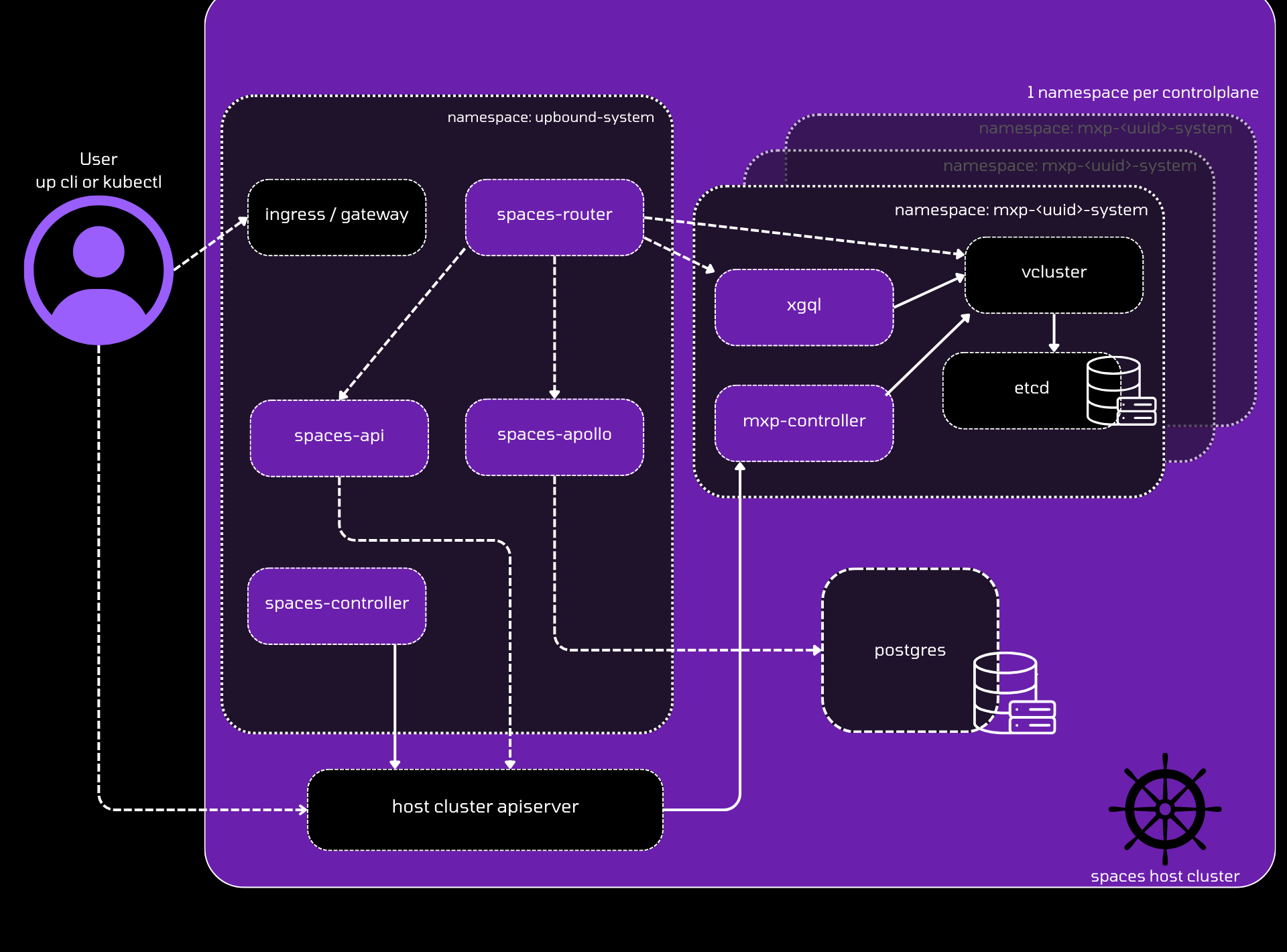
Spaces system components
Spaces is built from several system-level components that work together:
Spaces-router
Entry point for all Spaces endpoints. The router handles the following:
- Spaces API
- Spaces Apollo
- Control plane API servers
It reconciles control planes and dynamically builds routes to each control plane API server.
Spaces-controller
Reconciles Space-level resources, serves webhooks, and works with mxp-controller to provision control planes.
Spaces-api
API for managing groups, control planes, shared secrets, and shared telemetry objects. It is accessed only through Spaces-router.
Spaces-apollo
Hosts the Query API and connects to the Postgres database that is populated by apollo-syncer pods in each control plane.
Control planes and components
Each control plane runs in an isolated environment with a consistent set of components.
Namespaces
Each control plane gets a namespace with the pattern: mxp-uuid-system.
Namespaces are labeled with:
internal.spaces.upbound.io/controlplane-nameinternal.spaces.upbound.io/controlplane-namespace
Finding which cluster a control plane is in
# Search across all namespaces for a specific control plane
kubectl get namespaces -l internal.spaces.upbound.io/controlplane-name=<ctp-name>

# Get more details about the namespace
kubectl describe namespace <namespace-name>

# See what's running in that control plane's namespace
kubectl get pods -n <namespace-name>
Control plane runtime
Each control plane runs inside the Space cluster. Its main components are:
- API server — Often run in a single pod.
- Etcd — Data store for the control plane API server. It holds all user Crossplane resources.
- CoreDNS — Handles DNS resolution inside the control plane.
mxp-controller
Controller and webhook that runs per control plane. It:
- Handles control plane provisioning (installs Crossplane, kube-state-metrics, and related components)
- Manages resources inside the control plane API server (such as Crossplane)
- Serves webhooks
kube-state-metrics
Captures metrics around Managed Resource (MR) usage for billing. It counts resource usage so usage can be metered and billed appropriately.
vector
Used with kube-state-metrics to send MR usage data to bucket storage for billing.
apollo-syncer
Syncs control plane state into Postgres, which backs the Query API. It bridges Kubernetes storage (etcd) and the query system (Query API / Postgres).
External Secrets Operator (Spaces)
Uses the upstream External Secrets Operator to power the SharedSecrets feature in Spaces.